

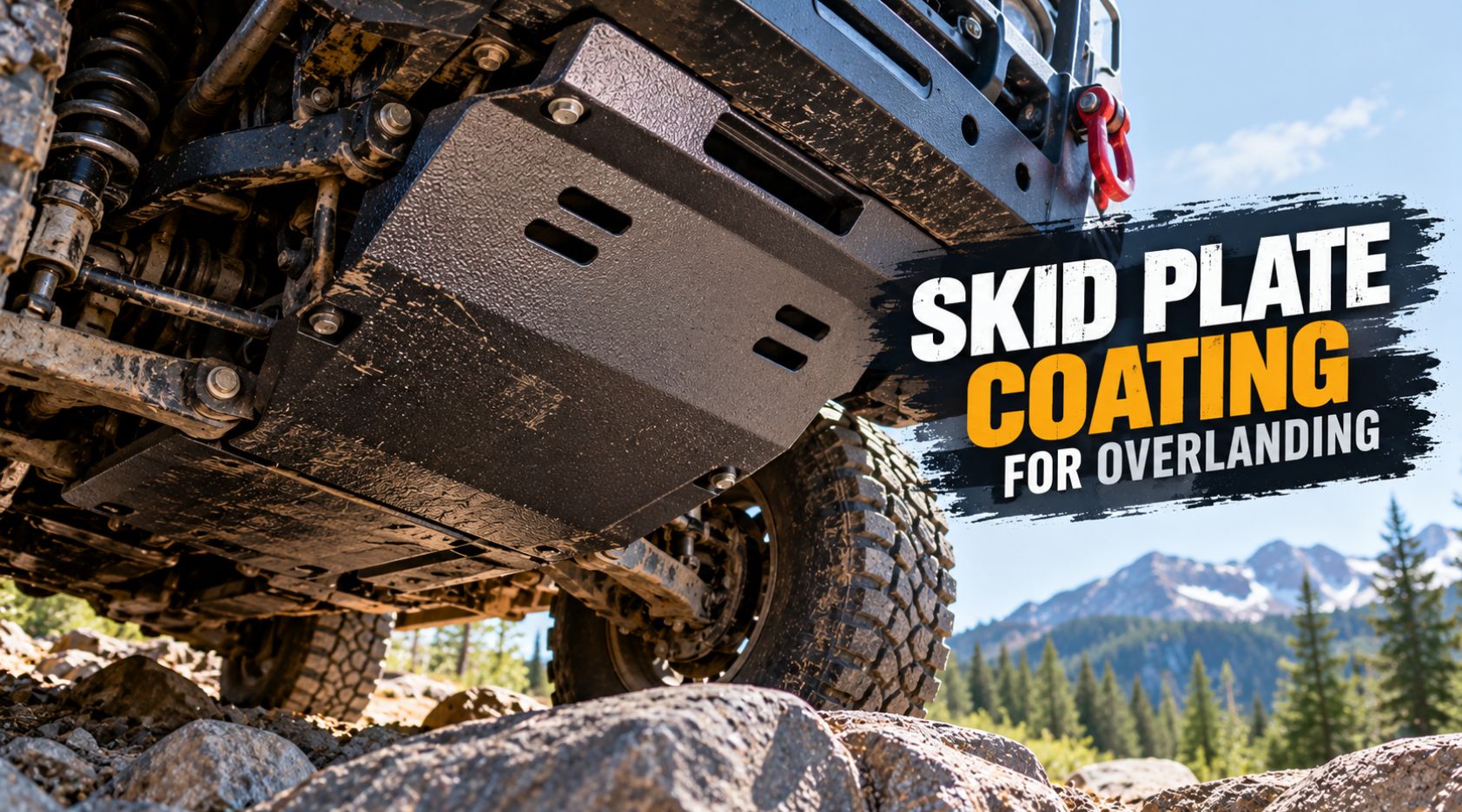
Drag a rig over a rock ledge at the wrong angle and you’ll hear it before you feel it, a sharp metallic scrape as the skid plate takes a hit that was meant for your oil pan, transfer case, or fuel tank. That’s the entire point of a skid plate, taking the abuse so something more expensive and harder to replace on the trail doesn’t have to. What a lot of overlanders don’t think about until it’s too late is that the skid plate itself needs protection too, and skid plate coating overlanding builds genuinely depend on is exactly the kind of upgrade that doesn’t matter at all until the one trip where it absolutely does.
This guide covers why bare and powder-coated skid plates still fail under sustained trail abuse, what coating options actually hold up, and how to think about this decision for your specific build.
What a Skid Plate Is Actually Protecting
Before getting into coatings, it’s worth being clear about what’s at stake underneath that plate. Oil pans, transfer cases, fuel tanks, transmission housings, and sometimes steering components all sit low enough on most overlanding vehicles to be vulnerable to rock strikes, stump hits, and general undercarriage abuse on technical trails. A punctured oil pan or fuel tank hundreds of kilometers from the nearest town isn’t an inconvenience, it’s a trip-ending, potentially expensive recovery situation.
Skid plates exist to absorb that impact instead of the component behind them, which means the plate itself is taking repeated, sometimes severe mechanical abuse over the life of a build. That reality is exactly why the plate’s own surface condition matters more than most builders initially think.
Why Bare Steel and Powder Coating Aren’t Enough
Bare steel skid plates, common on budget builds and older factory setups, offer zero corrosion resistance on their own. Every rock strike that chips through any factory finish exposes fresh steel directly to moisture, mud, and road salt, and a skid plate that’s constantly getting dragged through wet trail conditions, stream crossings, and winter driving accumulates rust at a rate that bare automotive sheet steel elsewhere on the vehicle simply doesn’t experience.
Powder coating is a step up and extremely common on aftermarket skid plates, offering decent initial corrosion resistance and a durable-looking finish. The problem is mechanical, not chemical. Powder coat is a relatively hard, somewhat brittle finish, and a direct rock strike doesn’t flex with the impact, it chips. Once chipped, that exposed point becomes a rust initiation site, and because skid plates take repeated impacts in roughly the same high-contact zones over a season of trail use, powder coating damage tends to concentrate exactly where protection matters most rather than spreading evenly across the plate.
What Actually Holds Up: Flexible Spray-Applied Coatings
This is where skid plate coating for overlanding applications starts looking a lot like the bedliner coatings a lot of builders are already familiar with from truck bed protection. Spray-applied polyurea and polyurethane coatings bond directly to the metal and cure into a flexible, textured film that behaves fundamentally differently than powder coat under impact. Instead of chipping on contact, the coating flexes and absorbs some of the impact energy, which both protects the underlying metal better and resists the kind of brittle fracture damage that creates rust-prone exposure points.
That flexibility matters specifically because of how skid plates get used. They’re not static protective panels sitting in a controlled environment, they’re taking direct, repeated, often sharp-edged rock contact at speed, and a coating that can absorb and distribute some of that impact rather than cracking under it holds up meaningfully longer under real trail conditions.
Steel vs. Aluminum: Does the Base Material Change the Coating Decision?
Skid plates come in both steel and aluminum, and the material affects more than just weight. Steel is heavier but dents and deforms under impact in a more predictable, often repairable way, while aluminum is lighter, which matters for overall vehicle weight and fuel economy on long overland trips, but can crack or tear under a severe enough impact rather than just denting.
Coating adhesion and surface prep requirements differ somewhat between the two metals, and aluminum in particular needs proper surface preparation, since skipping appropriate prep for aluminum substrates is a common reason coatings fail to bond properly regardless of how good the coating material itself is. Whichever base material a build uses, confirming the coating applicator has specific experience with that substrate matters more than assuming any coating process works identically across steel and aluminum.
Coverage: It’s Not Just the Flat Plate Surface
A thorough skid plate coating project covers more than the obvious flat protective surface. Mounting hardware, bolt heads, and the plate’s edges and corners, often the first points of contact on an angled rock strike, deserve the same coverage as the main face of the plate. Skipping these detail areas to save time or material is a common shortcut that undermines a lot of the protection the main coating is providing, since corrosion and impact damage both tend to start at edges and fasteners before spreading inward.
For plates that mount close to other undercarriage components, ensuring the coating doesn’t interfere with proper fitment or create clearance issues is also worth checking before and after application, since added coating thickness, while generally minor, can matter on a tightly packed undercarriage.
Comparing Skid Plate Finish Options
| Finish | Impact Behavior | Corrosion Resistance | Typical Longevity Under Trail Use |
|---|---|---|---|
| Bare steel | Dents, no protective barrier | Poor, rusts quickly once exposed | Short, requires frequent maintenance |
| Powder coating | Chips on sharp impact | Good until chipped | Moderate, concentrated wear points fail first |
| Spray-applied polyurea/polyurethane | Flexes, absorbs impact | Strong, continuous barrier | Longer, resists chip-and-rust cycle |
DIY vs. Professional Application for Skid Plates
Some overlanders handle smaller coating projects themselves using consumer-grade spray-on products, which can work reasonably well for touch-ups or lighter-duty builds, though achieving the same film thickness and bond quality as a professional plural-component spray system is genuinely difficult with a DIY approach. For a plate that’s going to see serious technical trail use, professional application tends to deliver a more consistent, durable result, particularly around the detail areas, edges, bolts, mounting points, that matter most for long-term protection.
For broader context on how spray-applied coatings get used across other parts of an overland build, our piece on overlanding trailer coatings covers the same general coating approach applied to a different, larger-surface-area part of a rig.
Things to Consider Before Coating Your Skid Plates
- What material are your skid plates, steel or aluminum, and does the coating process account for that substrate’s specific prep requirements?
- Is the plate currently showing chip damage or early rust at high-contact zones that needs addressing before new coating goes on?
- Will the coating cover mounting hardware and edges, not just the main flat surface?
- Does your typical trail use, mud, water crossings, rock gardens, justify a more durable flexible coating over standard powder coating?
- Is the applicator experienced with the specific base metal and the kind of impact-resistant coating your build actually needs?
Maintenance After Coating
Even a well-coated skid plate benefits from periodic inspection after serious trail runs, checking for any areas where a direct impact may have compromised the coating down to bare metal. Catching and touching up a small damaged area quickly prevents it from becoming a larger rust problem, the same logic that applies to coated truck beds and other high-impact vehicle surfaces. Keeping the underside of the vehicle reasonably clean of accumulated mud and debris also helps you actually see developing problem areas during routine checks rather than missing them under a layer of trail grime.
Frequently Asked Questions
Is a flexible spray coating really better than powder coating for skid plates?
For sustained, serious trail use, generally yes, since flexible coatings absorb impact rather than chipping the way powder coat does, which reduces the rust-prone exposure points that develop over a season of rock strikes.
Does coating a skid plate add significant weight?
The coating itself adds minimal weight compared to the base plate material, so it’s not a meaningful factor in the steel-versus-aluminum weight decision most builders are already making.
Can I coat my skid plates myself?
Lighter-duty DIY products can work for touch-ups or less demanding use, but professional plural-component spray application generally delivers better film thickness, bond quality, and detail coverage for a plate that will see serious trail abuse.
How often do coated skid plates need to be recoated?
It depends heavily on how hard and how often the vehicle is driven on technical terrain, but periodic inspection after major trips, with touch-up repair as needed, extends the coating’s effective life well beyond a one-time application with no follow-up.
Does aluminum need a different coating process than steel skid plates?
Yes, aluminum requires specific surface preparation for proper coating adhesion, so confirming the applicator has experience with aluminum substrates specifically matters before committing to a coating project on an aluminum plate.
Conclusion
Skid plate coating for overlanding builds is one of those upgrades that’s easy to overlook because the plate is already doing its job just by existing. But a plate that chips, rusts, and weakens over repeated trail seasons is protecting less effectively than one built to actually absorb that abuse over time. Choosing a flexible, properly applied coating over bare steel or standard powder coat, and covering the detail areas that matter most, is what keeps a skid plate doing its one real job for the life of the build instead of needing replacement sooner than the rest of the rig around it.