An overlanding route can be legally open and still be a poor choice after rain or snowmelt. Treat the condition of an unpaved road as its own departure decision, rather than assuming that an open gate or a capable vehicle settles the question.
This is researched planning guidance for travel on existing authorized roads, not a field report or a mud-driving tutorial. Current land-manager instructions, closures and conditions take priority.
Separate access permission from surface condition
Motor-vehicle access information answers where and when a vehicle class may travel. It does not promise a usable road surface. For example, the Forest Service’s Coconino travel-map guidance distinguishes route designation from passability and warns about wet-weather and other administrative closures. Use the current map and notices for your destination; this document is an example of the distinction, not a current road-status report.
Before leaving, check recent precipitation and the forecast alongside the local road-condition page. Ask the managing office about the actual road numbers and dates in your itinerary. “Is the forest open?” is a less useful question than “Is this unsurfaced connector appropriate for vehicle traffic after the recent rain?”
Choose a different trip before the road chooses for you
Build a wet-weather alternative around verified access: a surfaced approach, a developed campground or postponing the remote section. Confirm that the alternative’s own access is usable; a different pin reached by the same saturated connector is not a real fallback.
Agree on the decision before the convoy reaches the last junction. Everyone should know that declining a muddy road is an ordinary outcome, not a challenge to the vehicle or driver. Keep enough time, fuel and daylight in the plan to use the alternative without rushing.
Do not use traction as the environmental test
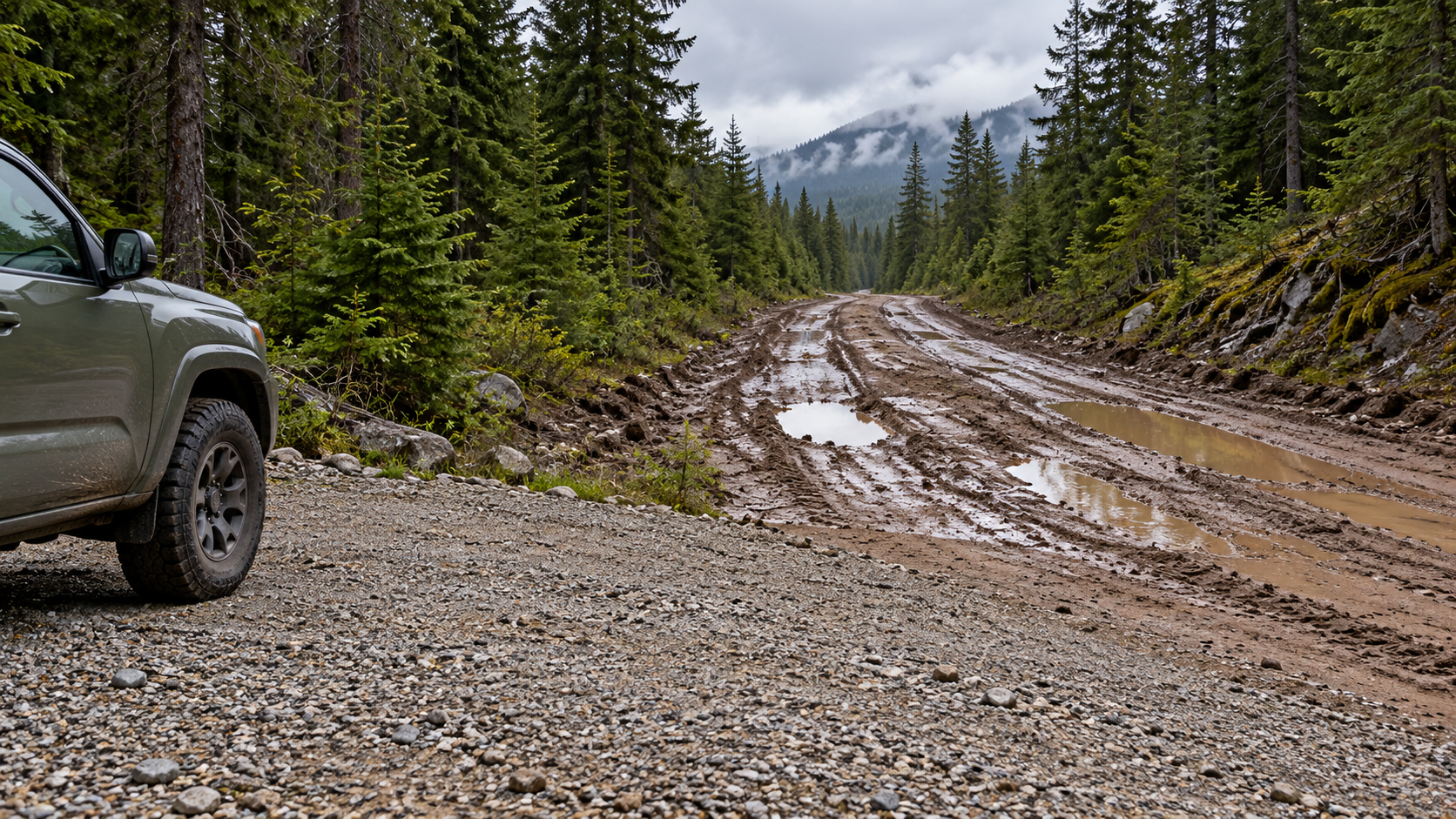
The question is not just whether the truck can keep moving. The Forest Service’s Malheur-area visitor guidance asks people to avoid water-saturated muddy roads and explains that vehicle weight and maneuvering can damage them. Tires and recovery equipment do not turn vulnerable road surfaces into an appropriate place to practice.
Do not drive into an uncertain stretch just to discover its limits. Assess from an already safe, permitted stopping location. National Weather Service flood guidance warns against driving or walking into floodwater; do not use a crossing to test the route. If the approach looks doubtful or the exit is uncertain, choose the verified alternative. This article intentionally gives no universal rut-depth, rainfall or drying-time threshold: conditions vary too much for a generic number to settle the decision.
Never create a bypass around the problem
A strip of vegetation beside a muddy section is not an invitation to widen the road. The Forest Service-hosted off-highway travel guide specifically advises against making new tracks around a wet stretch. Its relevant principle here is to turn back rather than extend the route into undisturbed ground.
Plan where to turn around before committing to narrow sections. Do not improvise a maneuver that creates a collision, rollover or edge-collapse risk. If you cannot retreat safely, stop and seek appropriate assistance rather than escalating the situation. Never bypass a closure barrier.
Record a useful observation, not a permanent verdict
If you decline the road, note the date, approximate time, road number and the condition observed from your safe location. A factual message such as “standing water and deep existing ruts visible at the west junction” is more helpful than “this road is always impassable.” Send significant damage information to the land manager through its published reporting route.
Keep the observation separate from official status. Your decision not to proceed does not create a legal closure, and another traveler’s successful crossing does not establish that the surface is ready for more traffic.
Use the offline navigation guide to prepare alternate exits and maps. The additional habit is simple: give road condition an independent yes-or-no decision, and let “not today” remain a successful trip outcome.
If equipment shopping is part of the plan, use the gear comparison worksheet to separate documented capability from assumptions. No equipment rating overrides a closure or makes a vulnerable road suitable for traffic.